Will Apple Vision Pro be Tim Cook’s Newton?
In many ways, the Apple Newton was John Scully’s legacy at Apple. When Steve Jobs returned after the NeXT aquisition, Newton was a pet project platform 20 years ahead of its time. If you haven’t seen Love Notes to Newton you should watch it!
Notwithstanding the issues Apple faced building their next-generation Operating System (which NeXTSTEP would ultimately become), on his return Steve Jobs saw an undisciplined company with too many product lines.
It’s now folklore that Jobs reverted Apple to the “4 quadrant matrix” of products comprising a consumer desktop (iMac) and laptop (iBook), and a professional desktop (PowerMac) and laptop (PowerBook).
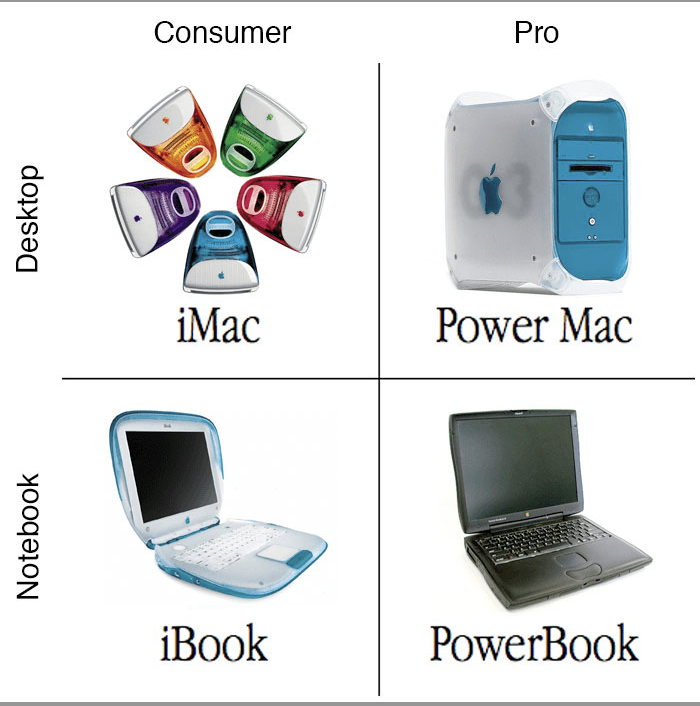
While the core ideas and technology from Newton would eventually define the modern Apple product line, at that point there was no room for the Newton with its entirely different OS in the 4 product matrix and so Jobs killed it.
Some of Newton’s most ardent fans even protested at Apple’s campus as referenced in this email from Steve Jobs recorded in Make Something Wonderful.
From: Steve Jobs
To: Apple employees
Subject: Newton protest today
Date: March 6, 1998, 8:09 a.m.Some people are understandably upset that Apple has decided to stop developing future Newton OS based computers, especially the MessagePad. Today some of them are coming to Apple to protest our decision. This is OK. We are reserving a space for them on our campus and will provide them with coffee and other hot drinks (it may be cold out there!).
Our decision to end Newton development was not taken lightly, and is unlikely to be reversed. Even so, let’s welcome the Newton customers and developers who come to protest this decision. Hopefully they will feel our enthusiasm about the future of Apple, and leave more settled than they arrived.
Thanks
Steve
So, why did Newton fail?
- Newton was constrained by immature hardware (too heavy & bulky, battery life too short).
- Newton was constrained by costing too much, few people would take the plunge.
- Newton was constrained by limited developer adoption, likely related to #2.
✤
I started my career in technology as a weekend casual at Mac’s Place 1 in the late 1990s.
I vividly remember watching Danny Gorog demo a Newton 2000 — the first model that really worked — to a customer who subsequently bought the demo unit off him. It was actuallly the only one we had in stock and had been on the shelves for months by then I might add!
The sales pitch was so compelling because Danny owned, used and loved his Newton (and was also an excellent salesperson!).
Just like Danny back at Mac’s Place, a friend and fellow Mac-nerd Damian Cavanagh is similarly a fan of Vision Pro, owns one and loves it. He works at CompNow 2 (in the Apple sales team) and has personally sold a bunch of Vision Pro devices.
Even so, to most industry obserervers it’s undeniable that the Vision Pro just isn’t in the mainstream yet. Having lived through both product launches, it’s eery to me how similar the Apple Vision Pro’s story feels at this point:
- Apple Vision Pro is constrained by immature hardware (too heavy & bulky, battery life too short).
- Apple Vision Pro is constrained by costing too much, few people have taken the plunge.
- Apple Vision Pro is constrained by limited developer adoption, likely related to #2.
✤
Interestingly, I’ve seen a change in the way Apple have been talking about Vision Pro of late. They now frame Vision Pro as “a product from the future we’ve reached forward and pulled back into the present”.
That’s not what they said at launch, of course. I think Apple has realised that Vision Pro is suffering the same problem as Newton. It’s currently an amazing technology demo (as was Newton) but not even close to ready for mainstream adoption.
The cancellation of the Newton wasn’t the end of the road for the technology that powered it, obviously. The iPhone, which took Apple from an ‘also-ran’ computer maker with a weird OS to the most lucrative platform on the planet, can trace the lineage of many of its core technologies directly back to Newton.
I often reflect that my iPad Pro is the ultimate expression of the vision of the eMate, durability of a drop test notwithstanding! It is powered by an ARM CPU, has a touch-first interface, keyboard and stylus with handwriting recognition.
✤
So, will Vision Pro be Tim Cook’s Newton?
For now, the future of Apple Vision Pro is over to John Ternus.
Will he put “spatial computing” back into the can until the hardware catches up, like Steve did with Newton?
Or can Apple afford to carry Vision Pro until it’s ready, in a way it couldn’t for Newton?
Only time will tell. ⏳
What I do know is that I won’t be surprised if we’re all using ‘Spatial Computing’ in 20 years and the kids can’t believe it almost didn’t take off! 🤷♂️
In Australia, the only place to buy a Mac (or Newton!) for many years was an authorised Apple Reseller. Mac’s Place was one such reseller, along side others such as CompNow, Choice Connections, NextByte, DesignWyse; Random Access, MyMac and others. (This was before the Buzzle debacle, and before Apple tried to rebrand the independent sellers into similarly branded AppleCentre “Location” stores… and long before the advent of the wholly Apple-owned AppleStore). ↩︎
One of the few surviving Apple Authorized Reseller brand names from the 90s, although back then they were called “Computers Now”. ↩︎